

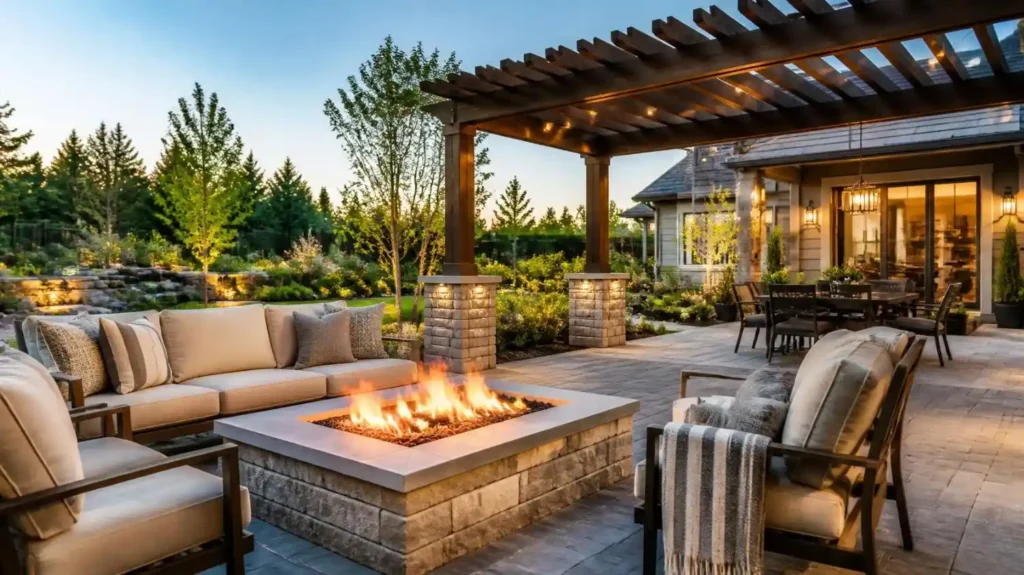
The blog explains about Outdoor Living Space Ideas with Fire Pits and Pergolas. Residents of the western New York region are considering how their backyards can do more. The old grassy area with a grill is now part of the house, where you can cook, relax and entertain until after dark. Two elements continue to play a large part in this evolution, and they’re found in nearly every backyard design discussion: fire pits and pergolas.
They get the summer going for you and the weather, for one. A strategically located fire pit extends the fire season into the fall, and a pergola can provide shade, structure, and room to an otherwise open yard. Mix the two carefully, and you have a backyard that is finished, rather than furnished.
This guide covers some of the simplest outdoor living NY ideas, including the different types of fire pits available and how to match them with your home’s design and budget to create a pergola that fits in perfectly.
Why Outdoor Living Spaces Are Trending in Western New York
Homeowners in warmer climates enjoy the year-round patio weather, but not so in Buffalo, Rochester and the rest of Western New York. Part of the reason outdoor living upgrades have become so popular here is that people want to make the best use of the months that they have and add a few more on either end.
The trend is being driven by a few local factors:
- Brief outdoor seasons translate to homeowners wanting more additional weeks of enjoyment in the spring and fall, rather than just July and August.
- With remote and hybrid work, backyards are double-duty as breakout spaces, leading to higher interest in backyard pergolas.
- There has been an increase in staycations, which has led homeowners to see their own backyards as worthy investments to staycation.
- Outdoor spaces that are completed are becoming more of a selling point for real estate agents who feature them in their listings in both Buffalo and Rochester, NY.
The outcome is a gradual increase in the popularity of fire pit pergola ideas that are climate-friendly instead of climate-unfriendly in New York.
Fire Pits: The Anchor of Any Outdoor Living Space
A fire pit is more than a source of heat. It creates a focal point as a fireplace does in an indoor living room. When deciding on a style, it’s important to consider how you’re going to use the space, whether it’s snug nights with a book, gathering with neighbors on weekends or evenings enjoying marshmallows with the kids.
Wood-Burning Fire Pits
Wood-burning pits provide the ultimate campfire experience, with crackling sounds, real smoke, and a variable fire size. Are less expensive to buy, but require more maintenance, such as ash pickup, wood storage, and watching for local burn rules.
Gas Fire Pits (Propane or Natural Gas)
Homeowners looking for convenience have opted for gas fire pits. They start up immediately, don’t create smoke or ash and can be constructed right into a patio or combined with a custom stone surround. Natural gas lines provide longer-lasting connections and propane tanks provide more flexibility in placement, particularly for pits further away from the house.
Fire Tables and Built-In Features
In order to achieve a more furniture-style appearance, there are fire tables available for many homeowners; they come in a flat-topped design and are used as a coffee table when not in use. These pair beautifully with contemporary pergola designs and outdoor furniture that is sectional.
Material Choices for Fire Pit Surrounds
- Natural stone is a great choice for use in landscape settings and hardscape patios.
- Concrete pavers – affordable and come in various finishes
- Brick – Characteristic of many older, established homes found throughout Western New York neighborhoods, this is a traditional look.
- Metal (steel or copper) – modern and low-maintenance, and is often used for portable fire bowls.
Pergolas: Adding Structure and Shade
When it comes to fire pits, it’s a case of the anchor and the frame the latter being the pergola. A pergola is not a complete enclosure, but instead creates a boundary that allows the area under the structure to be used as an outdoor room without it closing in, thus maintaining an open space while providing shade and privacy.
Traditional Wood Pergolas
Wood pergolas are still very popular due to their versatility and warmth. They accept reasonably well the humidity and freeze-thaw cycles of the New York region and are often used in the region as either cedar or pressure-treated pine, which are both sealed.
Vinyl Pergolas and Composite Pergolas.
Vinyl and composite pergolas are also becoming popular options for those who desire the pergola effect but do not want the maintenance. They are also not subject to rot, do not require repainting and often have longer warranties, a practical consideration for busy households.
Aluminum and Steel Pergolas
Metal pergolas have a more modern and streamlined design. If the homeowner wants to control how much sun and rain exposure they are getting, many newer models feature motorized louvered roofs that can be opened and closed based on the weather conditions.
Attached vs. Freestanding Pergolas
- Attached pergolas extend into the existing home, seamlessly connecting to the house and deck or patio.
- A freestanding pergola is suitable if the fire pit is located further away in the yard and forms a separate place from the other patio.
Combining Fire Pits and Pergolas for Cohesive Backyard Design
The most successful outdoor spaces don’t consider these features as standalone items they’re planned together. Some design guidelines aid in creating a unified presentation:
- Match materials, but not styles. If cedar posts are employed on the pergola, use natural stone or brick to bring in that same warm tone in the fire pit surrounding instead of cold, smooth concrete.
- Be prepared for smoke and air flow. When a pergola is placed directly above a wood-burning fire pit or close to it, ventilation is important. Many homeowners opt for a gas fire feature, or place the pit just outside the pergola footprints, with the seating area right under instead.
- Designate areas in the yard. One popular design is to have a pergola-covered dining or lounge area close to the house and a fire pit area further away, with a paver or gravel path between them. This helps to keep smoke out of the shaded seating area while maintaining a visual connection and continuity between the two areas.
- Layer the lighting. After dark, pergola string lights add depth with the softly glowing light of a fire pit, eliminating the need for overpowering overhead lighting.
- Consider views within the house. Even when it’s not in use during the season, the way that Western New York homeowners use the pergola and fire pit means that they are seen from the kitchen and living room, which is an added value.
Backyard Design Considerations Before You Build
A few practical questions should be answered before you are going to decide on a layout:
- What is the usable area of the yard? There are a number of factors that influence where a pergola or fire pit can be placed, including slope, drainage and pre-existing trees.
- What’s the prevailing wind direction? This will impact where the smoke goes from a wood-burning pit, and which side of a pergola will be best served by a lattice or privacy panel.
- What is the distance between the structure and the house or property line? Each municipality in the Buffalo, Rochester and Albany areas has different requirements for setbacks, so it is advisable to check early.
- Will it be an area for socializing or for relaxation? The bigger the party, the bigger the seating rings and the wider the pergola covering, and a smaller pit and cozier pergola is perfect for a couple’s getaway.
- How much food does the machine consume? Wood does need more maintenance than composite or metal, so this cost should also be taken into consideration when choosing a pergola or fire pit material.
Seasonal Use in Western New York’s Climate
The most significant of all the benefits of having a fire pit with a pergola is the fact that it extends your season. A pergola alone will help on hot, sunny days by reducing heat and glare. Cool evenings, a fire pit helps. They do this together to have a broader spectrum of conditions.
Some homeowners go so far as to include:
- Use retractable or louvered pergola roofs to keep out the rain on those unpredictable spring and fall days.
- Ceiling fans that are rated for outdoor use are to be attached to the pergola frame during warmer weather seasons
- Cover one or two sides of the pergola with wind or privacy screens to reduce the breezy air around the fire pit.
- Furniture covers that will keep investment furniture safe over the winter months when the space is dormant.
Furnishing and Accessorizing the Space
After installing the fire pit and pergola, it’s all about the furniture and the finishing touches to make the space feel comfortable and cohesive.
- Seating. Sectionals or Adirondack-style chairs with a loose circle around the fire pit allow for more conversation than a row of chairs. A pergola provides the space with more versatility, featuring a set of dining chairs for eating and lounge chairs for sitting around and enjoying the day.
- Textiles. Outdoor cushions, throw blankets and rugs fill in the spaces with color and warmth, and are not too demanding to maintain. In a climate with lots of hot sun and rain, it is wise to invest in fade-resistant and water-repellent fabrics.
- Lighting layers. In addition to string lights on the pergola beams, try using low-voltage path lighting that leads to the fire pit, and some lanterns or sconces on pergola posts for a more subdued light that won’t drown out the fire.
- Storage. A small bench, or a weather-tight deck box with storage, is available nearby and will store blankets, firewood, or cushions out of sight when not in use.
- Greenery. Planter boxes around the posts of the pergola or around a low hedge that surrounds the fire pit area help to temper a hard landscape, and are a common landscaping customer request when landscaping a new construction project to tie in with an existing garden or lawn area.
- Outdoor rugs and paths. Place a durable outdoor rug beneath the pergola dining area to visually define the area from the fire pit area, and create a gravel or paver path that connects the two areas, creating an easy flow of traffic at night.
Small details like these are often what make an outdoor living space feel finished rather than simply functional and they tend to be the easiest and least expensive upgrades to add after the main hardscaping and structural work is complete.
Cost Considerations
The price is dependent on material, size, and whether the solution is do-it-yourself or professional installation. As a general guide:
- The most basic wood-burning fire pit kits are usually the cheapest option.
- Gas fire pits with built-in surrounds are more expensive initially as a result of gas line installation and custom masonry construction.
- Pergola kits come in many different varieties depending on the material; wood kits are typically the least costly, while aluminum and motorized louvered systems are more expensive.
- Custom-built, attached pergolas with electrical and lighting represent the higher end of the investment range
The most certain way to determine an accurate number for a specific yard is to obtain quotes from a local landscaping or hardscaping company that is familiar with Western New York permitting and climate conditions.
Permits and Local Regulations
Permits are required for most municipal areas for permanent structures such as attached pergolas, gas line installations and built-in fire features; some municipalities have requirements regarding fire pit size, locations in relation to property lines and structures. The regulations may differ among towns and counties and this article is only for general design purposes and should not replace a visit to the town or county building department or the licensing of the contractor before construction.
Final Thoughts
In landscaping for outdoor living NY projects, fire pits and pergolas have become two of the most popular additions for some reasons: even with the shorter lifespan of outdoor living offered in this area, they create an inviting space for people to enjoy. But it’s important to plan them as a part of your design and not as an afterthought, because you can’t plan for how the space will be used all year, and smoke and airflow are factors.
Whether it’s a cozy spot for morning coffee or a complete entertaining space to host friends and family on the weekend, functional fire pit pergola ideas can transform a backyard into a true extension of the home, one that will endure Buffalo winters and be utilized throughout the year.
Frequently Asked Questions
1. How far should a fire pit be from a pergola?
The distance between the overhead structure and a fire pit will vary by manufacturer and local fire codes, but it is recommended to be at least a few feet. You can check with a local contractor for the correct clearance in a particular installation.
2. Can a fire pit go directly under a pergola?
With some gas fire features and non-combustible materials for pergolas, it can be done, but as soon as it comes to wood-burning pits, smoke and heat are usually the safety concern, so they’re better placed outside the footprint of the pergola.
3. What’s the most low-maintenance pergola material?
Aluminum and vinyl pergolas are the easiest to maintain, as they do not rot or need to be repainted, and are extremely resistant to moisture.
4. Do I need a permit for a fire pit in Western New York?
This depends on the Municipality and portable or permanent pit. There are also seasonal burn restrictions for wood-burning pits in some towns. It is recommended to contact the local building or fire department before installation.
5. What size fire pit is right for a small backyard?
Fire pits that are smaller and compact (about 30-36″ in diameter) generally will fit better in smaller yards, where space will allow for a walking path and a few chairs, but not too much.
6. Is a gas or wood-burning fire pit better for entertaining?
Gas fire pits tend to be easier to use for bigger groups of people wanting to entertain, as they light up quicker and won’t produce any smoke, whereas wood-burning fire pits will create smoke and a more rustic environment for smaller groups of people that prefer a more informal environment.
7. How long does a pergola typically last?
Wood pergolas can last for more than 10 years when they are sealed and maintained regularly. Vinyl, composite and aluminum will last for many more years with little maintenance.
8. Can a pergola be added to an existing patio?
Yes, it is possible to attach pergolas to an existing deck or patio, but there are some important considerations to take into account. It is possible to attach pergolas to an existing deck or patio, but there are some important considerations to bear in mind.
9. What’s the best flooring for a fire pit and pergola area?
Pavers, natural stone, and stamped concrete are popular options since they are durable, non-combustible and close to the fire pit and work with most styles of pergolas.
10. How do I keep smoke away from my seating area?
The best ways to reduce smoke spread to seating areas are to place the fire pit where the wind is blowing the least, to use a smokeless fire pit design, and to choose a gas one.