
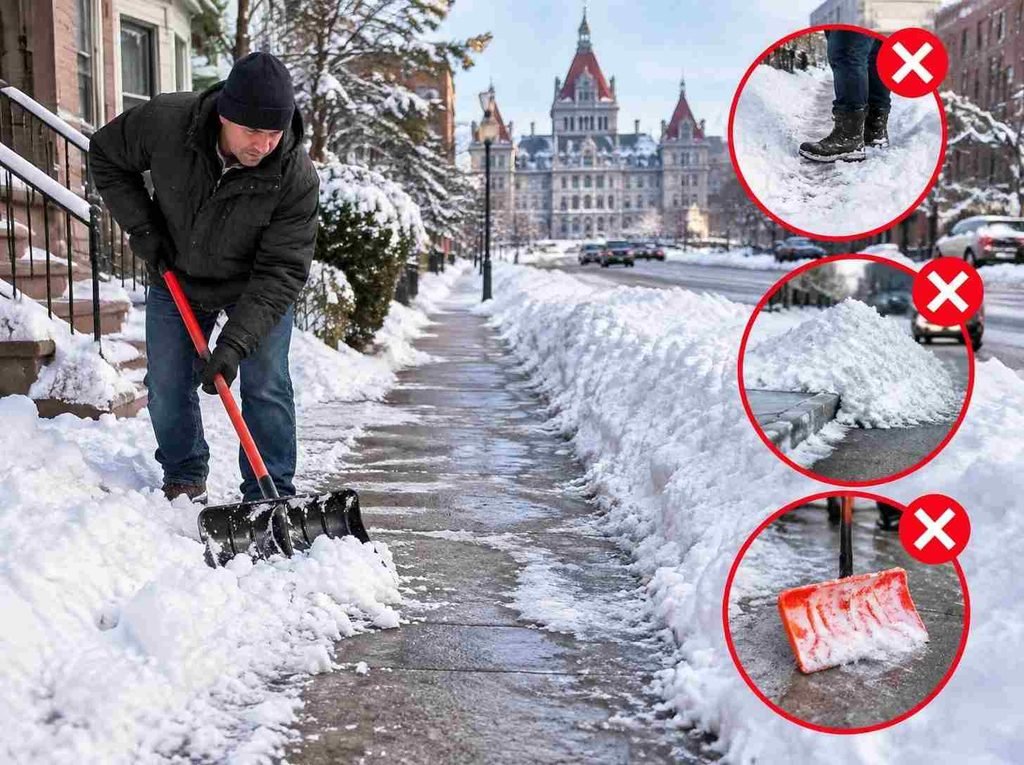
Sidewalk snow removal Albany NY: Common mistakes property owners should avoid is more than just removing snow from the sidewalk after a winter storm. Owners should also be mindful of the impact of their snow removal actions on pedestrian access, property condition, drainage, liability, and daily business activities. In Albany, snow and freezing temperatures, plus multiple winter weather changes, can make work on the sidewalks a daunting task, with mistakes that can cause larger issues. A walkway could be ice-free, but there might be melting snow, ice, or obstructions that block it.
Many homeowners aim to clear the snow off of the property as soon as possible, as though they were not worried about cleanup after. Others install the wrong equipment, put snow in the wrong places, and forget to snow certain areas which are frequently used by pedestrians. Such decisions can make the sidewalks hard to maneuver even if the main sidewalks are cleared.
Knowing the most common snow removal pitfalls on sidewalks will assist residential and commercial property owners in making their winter maintenance decisions. This guide addresses issues that have been overlooked, what the problems are and why they are important, and some solutions for better sidewalk clearing in Albany during the winter season.
1. Clearing Only the Main Walking Path
A frequent error in snow removal on the sidewalks is removing snow from the center of the sidewalk. This can make a noticeable visual path, but it doesn’t always allow for ample space for people to walk and move with ease and safety.
Two-way traffic can be particularly challenging, as can pushing a stroller, pushing a wheelchair, or being pushed in a wheelchair, in narrow paths. Snow may even slowly fall back onto the cleared surface along the sides.
Property owners should be mindful of the actual width and use of each pedestrian route and not just make a narrow gap through the snow.
How to avoid this mistake:
- Clear the full practical width of pedestrian pathways.
- Pay attention to entrances, gates, and connecting walkways.
- Keep enough space for people using mobility aids.
- Remove snow that may collapse from the sides onto cleared surfaces.
- Check whether pathways remain accessible after additional snowfall.
A well-maintained walkway should allow for normal pedestrian access rather than just a way through the property.
2. Pushing Snow Into Areas That Create New Problems
Removing snow from a sidewalk doesn’t necessarily mean it’s done. The locations of snow accumulations can cause further maintenance problems.
For example, when snow is pushed towards building access points, it can block access. Large piles can obstruct drivers and pedestrians sightlines in the vicinity of parking areas. Snow that falls near drainage points can also block water flow during warm-up.
This mistake is especially applicable to commercial buildings with several entrances, parking lots, loading docks, and walkways.
Better snow placement practices include:
- Identify suitable snow storage areas before winter begins.
- Keep entrances and emergency access routes unobstructed.
- Avoid covering drainage openings.
- Maintain visibility near driveways and pedestrian crossings.
- Keep snow piles away from areas where melting water could flow across walkways.
When developing a snow removal plan for your property, it’s important to look at the property layout as a whole, rather than just the sidewalk areas.
3. Using the Wrong Equipment for the Sidewalk Surface
Not every sidewalk can be maintained using the same equipment. The wrong shovel, snow blower, or mechanical clearing attachment may damage surfaces, especially when sidewalks contain decorative finishes, older concrete, pavers, or uneven sections.
The compacted snow left behind by heavy equipment can also be caused when narrow corners or areas near buildings are not accessible. Aggressive use of the metal edges of the shovels on sensitive surfaces can result in scratches or surface damage.
The equipment selected for a sidewalk should be based on the material, condition and width of the sidewalk.
Equipment considerations:
| Equipment | Suitable application | Important consideration |
| Plastic snow shovel | Smaller walkways and delicate surfaces | May struggle with heavy, compacted snow |
| Snow pusher | Wider, relatively flat sidewalks | Requires sufficient storage space for pushed snow |
| Snow blower | Larger pedestrian areas | Must be operated carefully around pedestrians and obstacles |
| Ice scraper | Localized ice removal | Avoid damaging the underlying surface |
| Hand shovel | Steps, corners, and narrow entrances | Requires additional time for larger properties |
Before winter, review the pavement conditions on the sidewalk and decide what equipment is suitable for the conditions. Appropriate equipment can minimize the amount of damage to property and enhance the quality of the removal operation.
4. Treating Every Snowfall as the Same Maintenance Job
Another error is relying on the same clearing method for each and every winter weather event. But various snow conditions call for different maintenance decisions.
The relatively easy snow removal might be a light, dry snow. Wet, heavy snow can be harder to push and can often compact under foot traffic. Even if snowfall is not abundant, freezing rain and changing temperatures can make for slippery surfaces.
This maintenance method may not be enough in a storm with wet snow and freezing temperatures.
Before choosing a method of clearing, property owners should assess the situation.
For example:
- Light snowfall: Clear snow before it is trampled by foot traffic.
- Heavy snowfall: If needed, plan for multiple snowfall clearings and use appropriate equipment.
- Wet snow: Be aware of weight and snow buildup around entrances and narrow spaces.
- Freezing Rain: Pay extra special focus on ice formation and surface treatment.
- Changing temperatures: Monitor areas where melting water could refreeze.
Understanding these differences can bring enhanced success to sidewalk clearing in Albany and reduce the potential of using an inappropriate maintenance technique.
5. Ignoring Sidewalk Transitions and Uneven Areas
Not all sidewalks are flat and continuous. It can be a ramp, steps, curb connections, driveway crossings, slopes and transitions between different paving materials.
The locations are easy to overlook, as property owners tend to focus on the larger level areas of the walkway.
But when snow covers changes in elevation, they can be hard to navigate when transitions are not even. Small buildup around curb ramp/step can impact access. Ice can form on inclined areas, which can also result in difficult walking.
Areas that deserve additional attention include:
- Curb ramps and pedestrian crossings.
- Steps leading to commercial entrances.
- Sloped pathways and driveway connections.
- Changes between concrete, asphalt, and paver surfaces.
- Walkways connecting parking areas to building entrances.
Inspecting after a successful clear allows a detailed analysis to be carried out to show areas that may require further work. Property owners should also determine if there are any existing surface issues that could have been uncovered by snow, such as cracks, raised edges of the pavers, etc.
6. Applying De-Icing Products Without Considering the Surface
De-icing products can aid in winter sidewalk maintenance, but can cause secondary issues if not used properly. Do not use more than recommended.
Each product comes with its own temperature limits, usage guidelines, and impact on other materials. Others can also damage vegetation, metal objects, concrete and adjacent landscaping if they are not used properly.
Another mistake is applying a de-icer without first removing loose snow. Surface treatments may be less effective when there is thick snow accumulation, and it is more difficult to manage ice through the snow.
Manufacturer directions should be followed, and the type and condition of the sidewalk taken into account when deciding on treatment.
Practical precautions:
- Remove loose snow before applying a de-icing product.
- Follow the recommended application quantity.
- Check the product’s effective temperature range.
- Consider compatibility with concrete and other paving materials.
- Avoid allowing products to accumulate near plants and landscaped areas.
- Follow up with additional inspection when temperatures change.
For commercial buildings, standardized application procedures can aid in minimizing the use of products and provide safer pedestrian access.
7. Forgetting About Snowmelt and Refreezing
One of the less obvious sidewalk snow removal mistakes occurs after the initial snow removal is done. Snow that accumulates around buildings, landscaping, or higher surfaces could melt during warmer weather. The result is that the water can flow onto sidewalks and refreeze if the weather gets cold.
This can result in thin ice, which is hard to recognise, especially in the early mornings or evenings.
This can be caused by downspouts, roof drainage, sloping pavement, and improperly placed snow piles.
Property owners need to focus not just on the magnitude of snow removal, but also on the direction of melting snow.
Ways to reduce refreezing problems:
- Inspect downspouts and drainage outlets near sidewalks.
- Avoid storing snow where meltwater can flow across pedestrian routes.
- Check low areas where water may collect.
- Pay attention to shaded sections that remain frozen longer.
- Reinspect sidewalks after daytime melting and overnight temperature drops.
It is essential to know the movement of water on a property when planning long-term maintenance for winter.
8. Overlooking Building Entrances and Pedestrian Access Points
Another avoidable mistake is to block a sidewalk without clearing the building entrance. Pedestrian access should have a straight path from the pedestrian sidewalk to the actual door.
Commercial buildings can have multiple access points such as customer access, employee access, delivery areas, and accessible points. Side doors, front steps and walkways to garages can also be found on residential properties.
If these areas are not cleared, individuals may be required to walk through areas that are not cleared or to take alternate routes that are not intended for pedestrian use.
Property owners should develop a plan to create a pedestrian network that links all the regularly patronized entrances on the property.
For businesses that have customers, suppliers, contractors, and visitors throughout the day, this is particularly important.
After clearing, it should be checked by a complete maintenance inspection that entrances, thresholds, steps and connecting walkways can be reached.
9. Waiting Too Long Before Starting Snow Removal
Delaying sidewalk clearing until the snow has accumulated significantly can make maintenance more difficult.
It’s usually easier to remove the fresh snow before it gets compacted by people or vehicles. Frequent walking in snow can form a firmer layer of snow.
This can make removal more challenging and can make it harder to restore the original walking surface.
The after-the-storm approach may also not be appropriate for properties that require pedestrian access multiple times per day.
A more effective method is to put in place a weather monitoring and maintenance plan.
For example, here are some things that property owners can do:
- Monitor local winter weather forecasts.
- Arrange inspections during extended snowfall.
- Schedule additional clearing when accumulation increases.
- Prioritize busy pedestrian entrances.
- Check pathways after storms and changing weather conditions.
In addition, the response time should consider any local requirements that apply. Property owners must refer to the latest City of Albany ordinance and guidance rather than take one general period of time as applying to all properties.
10. Failing to Coordinate Snow Removal Responsibilities
In general, commercial properties have multiple tenants or landlords, each of which is accountable for various aspects of the property. The building owner can oversee the building, a tenant can operate the building on a day-to-day basis, and an outside contractor can conduct winter maintenance.
When there are no clear responsibilities, some parts of the sidewalk may be overlooked.
An example of this is when a contractor removes the main walkway, but building management assumes steps and side entrances are not part of the area to be removed. Tenants also may think that the property owner is responsible for keeping the sidewalk outside their business in good condition.
All of this can lead to discrepancies in maintenance and delays.
A clear responsibility plan should identify:
| Maintenance responsibility | What should be clarified |
| Main sidewalks | Who arranges routine clearing? |
| Building entrances | Who checks steps and access points? |
| Side pathways | Are secondary walkways included? |
| Ice treatment | Who selects and applies suitable products? |
| Post-storm inspections | Who confirms that clearing is complete? |
| Contractor communication | Who reports missed or recurring problem areas? |
Having written agreements and documented maintenance procedures can minimize confusion, especially if there are several businesses sharing a commercial property.
11. Not Keeping Records of Winter Maintenance
Many property owners focus on the construction but not on documentation. Winter records of maintenance, however, can be useful in illustrating winter management and in determining those areas that need to be addressed on a regular basis.
This is especially helpful for commercial property managers who are responsible for coordinating staff, tenants and snow removal companies.
Records do not need to be complicated. A simple digital log can include:
- Date and time of each inspection.
- Weather and snow conditions.
- Areas that were cleared.
- De-icing treatments applied.
- Maintenance problems identified.
- Follow-up work completed.
- Contractor visit details.
Photographs can also be used as a tool to document the pre- and post-maintenance conditions of sidewalks.
Accurate records enable effective communication and allow property owners to review and assess their current winter maintenance practices.
Documentation should not replace good maintenance or legal representation but can be a valuable component of good property management.
Conclusion
Planning, equipment, and details that can be overlooked are all important in sidewalk snow removal Albany NY. Limited access to pathways, building snow piles close to drainage areas, improper equipment, not checking for melting snow, and not checking entrances will all dampen the effectiveness of snow removal.
For homeowners and home buyers, these are things to keep in mind to avoid these mistakes. All sidewalks should be viewed as part of an overall access system of entrances, parking lots, pedestrian paths and adjacent public areas.
By having a consistent maintenance plan, regular inspections, correct ice management and clear responsibilities for the contractors, properties can stay accessible through winter.
With a good snow removal company, managing winter maintenance can be easier. Call KD Landscaping to talk about how you’re going to keep your property safe over the winter and ask for a complimentary quote for snow removal.
Frequently Asked Questions
1. What are the most common sidewalk snow removal mistakes?
Common mistakes include clearing only narrow sections, leaving snow near entrances, using unsuitable equipment, applying excessive de-icing products, overlooking drainage problems, and failing to inspect sidewalks after the initial clearing.
2. Why is sidewalk snow removal important for Albany property owners?
Proper sidewalk maintenance helps maintain pedestrian access, supports safer movement around properties, reduces avoidable winter disruptions, and helps property owners address their local maintenance responsibilities.
3. When should property owners begin clearing sidewalks after snowfall?
Property owners should monitor snowfall and begin maintenance as appropriate for the weather conditions, pedestrian activity, and applicable local requirements. They should also check current City of Albany rules for specific obligations and timeframes.
4. Can using too much de-icing product damage sidewalks?
Yes. Some de-icing products may affect concrete, surrounding vegetation, and nearby materials when used incorrectly. Property owners should follow manufacturer instructions and select products suitable for the sidewalk surface and temperature conditions.
5. Why should property owners inspect sidewalks after snow removal?
Follow-up inspections help identify new snowfall, remaining ice, melting water, blocked drainage areas, and other problems that may develop after the initial clearing work.
6. What should commercial properties include in a sidewalk snow removal plan?
A commercial plan should cover pedestrian entrances, accessible routes, connecting sidewalks, steps, drainage areas, snow storage locations, inspection schedules, contractor responsibilities, and maintenance documentation.
7. Is professional sidewalk snow removal suitable for commercial properties?
Yes. Professional services can help manage larger pedestrian areas, multiple entrances, equipment requirements, and ongoing winter maintenance needs. Property owners should confirm the exact services and responsibilities included before hiring a provider.
8. What areas of a commercial property should be included in sidewalk snow removal?
Commercial snow removal should include public-facing sidewalks, building entrances, employee access routes, pedestrian crossings, curb ramps, steps, and walkways connecting parking areas to buildings. All regularly used pedestrian routes should be considered.
9. How can property owners prevent snow from accumulating again on cleared sidewalks?
Property owners can monitor weather conditions, arrange follow-up inspections, remove wind-blown snow, and check areas where snow may drift back onto cleared pathways. Regular monitoring is especially useful during prolonged snowfall and windy conditions.
10. What should property owners look for when hiring an Albany sidewalk snow removal company?
Property owners should consider the company’s experience, available equipment, service coverage, response arrangements, insurance, and approach to ice management. They should also confirm which sidewalks and entrances are included in the service agreement.


