
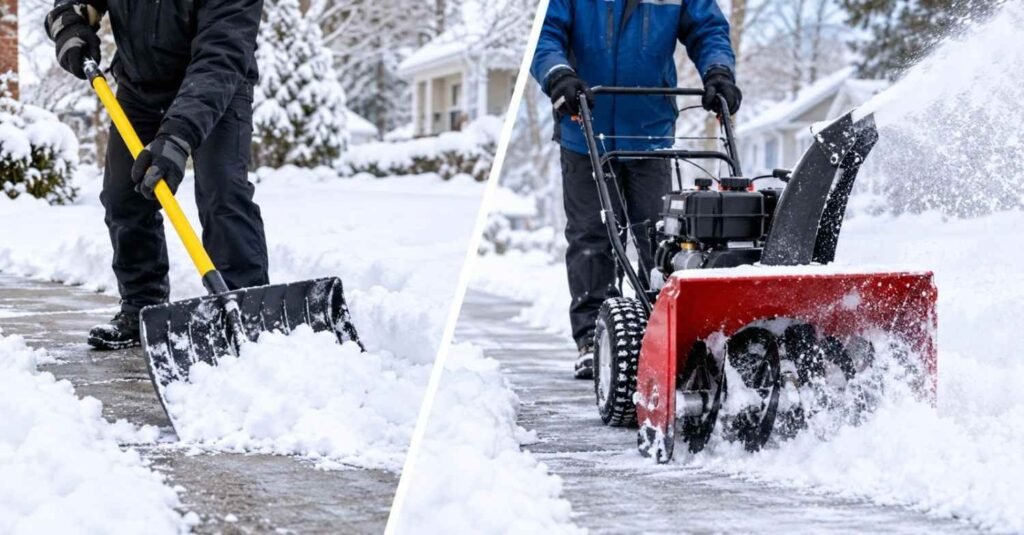
Sidewalk Snow Removal Albany NY: Snow Shoveling vs. Snow Blowing is an important topic for property owners and businesses preparing for the winter season. Selecting the proper snow removal equipment can have an impact on the speed of sidewalks being cleared, the amount of labor needed and how easily people can access a property when it is snowed up. Snow shoveling Albany NY, and snow blowing Albany NY are both effective, depending on the amount of snow to be removed, sidewalk width, surface conditions, and depth of snowfall.
If you are a homeowner, property manager, retail store, office building or commercial property, knowing about the two methods can help you keep your property more efficiently going into the winter. Snow blowers can be used to remove snow for a larger area in favorable conditions, but shoveling provides direct control in hard-to-reach areas. Awareness of the pros and cons of each technique helps in planning for a reliable bid to clear snow reliably in Albany’s winter weather.
Why the Right Sidewalk Snow Removal Method Matters
Sidewalks are vital pedestrian access to the community, customers, employees, delivery persons and visitors. A relatively small level of snow can make a walkway difficult to use, particularly if the snow turns compact or freezes due to a temperature change.
Winters in Albany may produce a variety of snowfalls, such as light and powdery or heavier, wetter falls. What is effective for a light snowfall may not work as well after a major storm. The following factors should be taken into account when determining the size of area, equipment available, type of surface material and speed at which the walkway must be cleared:
Property owners may be able to help by selecting the most appropriate method:
- Clear pedestrian routes more efficiently.
- Reduce unnecessary physical effort and repeated work.
- Reach narrow spaces around entrances, steps, and obstacles.
- Manage snow before foot traffic packs it down.
- Keep sidewalks more accessible during changing winter conditions.
- Plan labor and equipment requirements for commercial properties.
The objective is not just to clear the sidewalk of snow. To make a reasonably clear and usable walkway and deal with any remaining ice or compacted snow suitably.
What Is Snow Shoveling?
Manual snow removal is a method of clearing snow that involves using a shovel to lift, push, or move snow out of the way of a walkway. It is still a viable choice for narrow sidewalks, paths, steps, doorways and locations where larger equipment can’t maneuver as easily.
Advantages of Snow Shoveling
1. Better control in small spaces
The shovel can be used to maneuver around railings, signposts, benches, doorways and landscaping. This can be helpful on sidewalks that have multiple obstacles or multiple turns.
2. Suitable for narrow walkways
There are paths that are too narrow for a snow blower to pass comfortably. Shoveling increases the flexibility of the operator in the process of clearing tight pedestrian ways.
3. No fuel or charging requirements
You don’t need to use a battery, electricity or gasoline for a manual shovel. When available, it can be used as soon as the operator can put it to use and has appropriate winter gear.
4. Useful for finishing work
If a snow blower has a good shot at doing all but the snow near steps, corners, entrances, and edges, it can be removed with a shovel, even if the blower could do most of the job. Can be a helpful tool to use for cleanup.
5. Easy to transport and store
A shovel is somewhat easy to store and can be placed close to an entrance where it will be readily available during light snow.
Disadvantages of Snow Shoveling
Snow can be hard to shovel if it’s deep, wet, and covers a long sidewalk. Lifting and pushing are physical activities that need to be repeated several times and can be time-consuming.
Potential disadvantages include:
- Higher labor requirements for large areas.
- Physical strain from repeated lifting, twisting, and pushing.
- Slower progress during heavy snowfall.
- Difficulty moving large piles of wet, heavy snow.
- The need for repeated clearing when snow continues to fall.
.
If the property is a commercial building that has long sidewalks or multiple entrances, use of manual shoveling alone may necessitate a greater number of workers and a longer shoveling time.
What Is Snow Blowing?
Snow blowing is the process of removing snow by means of a machine powered by a motor or engine that generates a vacuum to pull the snow in and then blows it out of a chute. A snow blower can be electric, battery or gas-powered. Machines come in a variety of sizes and capacities, and size selection depends on the width of the walkway and the amount of snow the machine will encounter.
Advantages of Snow Blowing
1. Faster clearing across larger areas
Many open sidewalks can be cleared faster than by hand with a snow blower. It can be especially helpful for commercial buildings that have extended walkways.
2. Less repetitive lifting
The operator uses a machine to move along the snow surface without lifting and carrying snow over and over. This may alleviate some of the physical demands of manual removal, but using a snow blower will still take work and concentration.
3. Helpful during substantial snowfall
If there is more than a light dusting of snow, a suitable snow blower can be used to move larger amounts of snow. It may be preferable to clear in manageable passes rather than waiting until the accumulation is so large that it can no longer be handled.
4. Consistent clearing over open paths
When sidewalks are relatively straight and wide, a snow blower can have a continuous operation. This can be helpful if there are multiple paths from a house up to the residence.
5. Useful for recurring winter maintenance
Powered equipment can help crews clear snow from a wider area in a shorter time for businesses that require frequent snow removal on their sidewalks.
Disadvantages of Snow Blowing
Not all sidewalks are suitable for snowblowing. A machine may not have enough mobility in confined areas, around obstacles or on uneven surfaces. Some models may also be too wide or heavy for narrow paths.
Other limitations include:
- Equipment purchase, rental, fuel, charging, and maintenance costs.
- Noise from certain models.
- Possible damage to delicate surfaces if the machine is used incorrectly.
- Snow discharge that may block another walkway, entrance, road, or neighboring property.
- Reduced performance when snow is very wet, densely packed, or outside the machine’s capacity.
- The need for safe handling, protective equipment, and operator training.
Use snow blowers following the manufacturer’s guidelines. Operators are cautioned to avoid operating the machine with hands or feet on moving parts, or to clear a clogged chute by hand while the chute is moving.
Snow Shoveling vs. Snow Blowing: Main Differences
It will depend on the property’s condition as to which would be the best method. Here are several comparisons of common practical considerations.
| Factor | Snow Shoveling | Snow Blowing |
| Best suited for | Small paths, steps, corners, and narrow spaces | Longer sidewalks and open pedestrian routes |
| Clearing speed | Usually slower over large areas | Often faster over suitable open areas |
| Physical effort | Repeated pushing and lifting | Less manual lifting, but still requires machine handling |
| Equipment cost | Generally low | Higher purchase, rental, and maintenance costs |
| Space requirements | Works in tight spaces | Requires enough room for the machine |
| Obstacles | Easy to work around | May require additional manual cleanup |
| Light snowfall | Very practical | May be unnecessary for small areas |
| Deep accumulation | Can be time-consuming | Suitable models can move larger amounts of snow |
| Wet, heavy snow | Requires considerable effort | Performance depends on machine capacity and snow conditions |
| Finishing work | Very useful around edges and entrances | May leave areas that need manual cleanup |
In all cases, neither method is better off automatically. For many properties, it makes sense to use a snow blower to clear open areas and a shovel to clear detailed areas.
Which Method Works Best for Albany’s Winter Conditions?
The effectiveness of each method varies with the weather conditions. Equipment and timing should be determined by the amount of snow falling and cannot be standardized for each storm.
Light, Powdery Snow
Generally, light snow is easy to shovel or snow plow. If the walkway is short (less than 20 feet), shoveling might be the only maintenance required. A snow blower for a long commercial sidewalk can cut the time needed to clear the sidewalk.
If it snows lightly and before it gets heavy, then try to get it removed before it is a problem.
Wet and Heavy Snow
Manual lifting of snow may be difficult in wet snow conditions and could cause extra wear and tear on the snow removal equipment. A proper snow blower will help, but this will depend on the type of snow blower, its power and capacity.
In cases of heavy or thick accumulations, operators must follow the manufacturer’s instructions, do passes that are not too large, and not over-stress the equipment. A shovel might still be needed at entrances and other restricted locations.
Deep Snow After a Major Storm
If there is a lot of snow, the width of the sidewalk may be an important factor. It may still be necessary to clear a small pathway manually, but for a large commercial site it might be necessary to use powered equipment and more workers.
A section of the sidewalk might need to be cleared at a time as well. Early snow removal from the pedestrian route will help avoid forming a hard-to-manage snow accumulation.
Snow Near Steps and Entrances
Typical places for careful manual work are steps, door thresholds, narrow landings, and tight corners. Snow blowers might not fit safely in these areas, or they may blow the snow back onto an area that’s already cleared.
These details are often more easily cleared by the use of shovels. Once the snow is gone, property managers should inspect for compacted snow and slick spots to prevent accidents.
Choosing the Right Method for Residential Sidewalks
Residential sidewalks can have requirements that are different from those in large commercial properties. It doesn’t have to be large, but a walkway might have steps, a slope, garden edges, or a walk-through.
Shoveling the snow might be appropriate when:
- The sidewalk is short and narrow.
- Snowfall is light or moderate.
- The property has several small sections that need careful clearing.
- A powered machine cannot fit safely.
- The owner wants to avoid equipment storage and maintenance costs.
When it comes to snow removal, consider snow blowing when:
- The sidewalk is long or wide.
- Snow accumulates frequently.
- There is adequate room to operate the machine.
- The owner already has suitable equipment.
- Manual clearing would take too much time or effort.
Some homeowners employ both approaches. A snow blower is used to clear a main path, and a shovel is used to clear the edges, steps, and entrance areas. When there are open areas as well as enclosed areas in the layout, this combination may be helpful.
Why Commercial Properties May Need a Different Approach
A commercial property can also experience increased foot traffic and be more expansive. Retail businesses, office buildings, apartment complexes, medical offices, and other hospitality-related facilities can have multiple entryways, connecting paths, delivery access, and walkways for customers.
These sites require commercial snow removal planning with factors in mind such as number of sidewalks, snowfall forecast, staff available, and time to get sidewalks open.
When Snow Blowing Can Help Commercial Properties
Large, clear sidewalks with plenty of room between the sidewalk and traffic may make a snow blower a convenient option. They can assist in clearing large areas more quickly in snowy conditions.
But a snow blower cannot be considered a total solution. Shovels might still be required in tight corners, steps, entrances, and near obstacles.
When Shoveling Is Still Necessary
Hand clearing is still necessary at building entrances, ramps, railings, narrow areas, and where equipment cannot be maneuvered safely. It also enables the removal of snow from a specific area without sending it towards another walking route.
When a single technique is not suitable for all areas of the site, a combination of techniques can be used in commercial property management.
Planning for Multiple Sidewalk Areas
One way to do this is to break the property into sections:
- Main pedestrian entrances.
- Primary sidewalks connecting parking and building access.
- Side paths and secondary entrances.
- Steps, corners, and confined spaces.
- Areas that need a final inspection for remaining snow or ice.
The sequence should be pedestrian and based on the needs of the operation of the property. One path may open up the space for snow to build up, so crews should evaluate whether snow has been moved and whether it may be blocking another route to the building.
Cost Comparison: Shoveling vs. Snow Blowing
The price for snow removal on the sidewalk is based on property dimensions, snowfall frequency, labor costs, equipment and service agreement. Prices vary by property in Albany.
| Cost consideration | Snow Shoveling | Snow Blowing |
| Initial equipment | Usually inexpensive | Higher cost for powered equipment |
| Labor | May require more labor for large areas | May reduce clearing time on suitable routes |
| Ongoing expenses | Replacement shovels and worker time | Fuel or electricity, maintenance, repairs, and replacement parts |
| Storage | Minimal space | More storage space may be required |
| Small sidewalk | Often economical | May not justify equipment costs |
| Large commercial sidewalk | Labor can add up | May offer time savings when conditions are suitable |
It’s important for a property owner to look at the overall price for the completion of the work, instead of just equipment costs. For small sidewalks, a low-cost shovel might be enough, but in larger businesses, powered equipment or a professional may be warranted.
When recruiting a contractor, find out how they charge for their work per visit, by the size of the property, snowfall or on a seasonal basis. Get clarification on what is covered and if extra charges will apply for ice treatment or snow hauling.
A Practical Decision Guide for Albany Property Owners
The following guide may be useful for deciding which approach to use for a specific sidewalk.
| Property or condition | Suggested approach | Reason |
| Short residential path with light snow | Shoveling | Simple and practical for a small area |
| Long, open commercial sidewalk | Snow blowing, with shovel finishing | Can speed up clearing over suitable open sections |
| Steps and narrow entrances | Shoveling | Provides more control in confined areas |
| Large area after heavy snowfall | Suitable snow blower plus manual clearing | Helps move larger amounts while covering difficult details |
| Uneven or delicate paving | Method appropriate to the surface and equipment guidance | Helps reduce the risk of damage |
| Sidewalk with many obstacles | Shoveling or a mixed approach | Easier to work around objects |
| Property with repeated winter accumulation | Planned combination of methods | Supports regular maintenance across different conditions |
This is not a rule, but rather a starting point. The final decision should be based on snow depth, moisture, temperature, machine capacity, and the layout of the property.
Final Thoughts
Choosing between snow shoveling and snow blowing depends on the size of the sidewalk, the type of snowfall, the surface, and how quickly the area needs to be cleared. Shoveling offers flexibility and control around steps, corners, and narrow entrances. Snow blowing can save time on larger, open pedestrian routes when the equipment is suitable for the conditions.
For residential properties, a shovel may be enough for smaller paths, while a snow blower can be useful for longer walkways. Commercial properties may benefit from combining both methods as part of a planned winter maintenance routine.
Reliable Sidewalk Snow Removal Albany NY begins with selecting the right method for each section of the property. By considering equipment, labor, surface conditions, and remaining ice, property owners can make better decisions about sidewalk snow clearing throughout the winter.
Frequently Asked Questions
1. Is snow shoveling better than snow blowing for sidewalks?
Shoveling is usually more practical for narrow paths, steps, and corners. Snow blowing can be faster on larger, open sidewalks when conditions suit the equipment.
2. Is snow blowing faster than shoveling?
Snow blowing is often faster across large, open areas. The actual time depends on snow depth, moisture, sidewalk width, and machine capacity.
3. Can a snow blower be used on a narrow sidewalk?
Some compact models can work on narrow sidewalks, but the machine must fit safely and be suitable for the surface. Manual clearing may be better in tight spaces.
4. Should I shovel wet snow or use a snow blower?
Both methods can be challenging with wet, heavy snow. Choose equipment suited to the conditions and avoid lifting excessive loads or overloading the machine.
5. Which method is more affordable for a small sidewalk?
A shovel is usually the lower-cost option for a small walkway because it requires little equipment investment. Labor and physical effort still need to be considered.
6. Can commercial properties use both snow shoveling and snow blowing?
Yes. A snow blower can clear suitable open sections, while shovels handle steps, entrances, narrow paths, and areas around obstacles.
7. Does snow blowing remove all ice from a sidewalk?
No. Snow blowing removes snow but may leave a slippery surface or packed snow. The walkway should be inspected and treated for ice when necessary.
8. How often should sidewalks be cleared during snowfall?
The frequency depends on snowfall intensity, pedestrian traffic, property needs, and applicable local requirements. Repeated clearing may prevent snow from becoming compacted.
9. What should I consider before buying a sidewalk snow blower?
Consider sidewalk width, expected snowfall, surface type, machine capacity, storage, maintenance, noise, and where discharged snow will accumulate.
10. When should I hire a professional sidewalk snow removal service?
Professional service may be useful for large commercial properties, frequent snowfall, multiple entrances, limited staff, or situations where reliable clearing is difficult to manage internally.


