
Snow & Ice Management Albany NY: How De-Icing Helps Prevent Slips and Falls is a crucial issue for commercial property owners looking to make their buildings, walkways, and parking areas safer during the winter season. Slippery surfaces can result from snowfall, freezing rain, melting snow, and overnight temperature changes, and are hard to see. Professional de-icing Albany NY services will help keep ice buildup under control, increase traction, and lower the hazards for pedestrians entering or leaving a property. If combined with proper products and regular checks, businesses can keep their outdoor areas safer this winter by being prepared to take down snow and ice in a timely fashion.
Why De-Icing Is Important for Albany Properties
Businesses, apartment complexes, shopping centers, offices, medical properties, and other commercial properties may find winter weather in Albany to be challenging. Snow isn’t always in soft, easily removed conditions. If it gets cold at night and warm during the day, the snow can melt and refreeze to form a hard layer of ice.
This process can impact numerous areas around a house, such as:
- Main entrances and exit doors
- Sidewalks and pedestrian walkways
- Parking lots and parking spaces
- Loading areas and delivery entrances
- Outdoor stairways and ramps
- Pedestrian crossings and curb cuts
- Areas around dumpsters and service doors
- Paths connecting parking areas to buildings
Just a thin layer of ice can make walking difficult. A clear layer of ice on dark pavement, concrete, or in shaded walkways may not be noticed by visitors until they step on it.
A planned commercial ice removal service will aid property managers in determining vulnerable areas, deciding on the ice removal treatment, and responding when conditions change. De-icing should not be a stand-alone initiative following a big snow event, but rather be included in an overall winter maintenance strategy.
What Is De-Icing and How Does It Work?
De-icing: The use of an appropriate substance to assist in melting existing ice or to release a frozen surface from its bond with a paved surface. Treatment may facilitate the removal of ice from the product and influence its tendency to form slippery layers depending on the product and weather conditions.
The most common de-icing materials are sodium chloride, calcium chloride, magnesium chloride, and some blended de-icing products. Such materials are different and will depend on ice cover, moisture, application rate, and pavement temperature.
For instance, regular rock salt loses its effectiveness in cold weather. The New York State Department of Environmental Conservation provides this explanation of what happens to rock salt below about 15°F. An alternative product or a traction material should be used in colder weather.
Deicing is not just covering the pavement with salt. The aim is to use the correct treatment at the correct time, at the correct rate, with due regard for the safety, surface, and environmental concerns.
De-Icing vs. Anti-Icing
While these terms are associated, they are different ways of winter maintenance.
| Feature | De-Icing | Anti-Icing |
| Main purpose | Treats ice that has already formed | Helps prevent ice from bonding to a surface |
| Typical timing | After ice develops or freezing conditions occur | Before an expected icing event |
| Common applications | Icy sidewalks, entrances, ramps, and parking areas | Selected paved surfaces before freezing precipitation |
| Main benefit | Helps loosen or melt existing ice | Can make later ice removal easier |
| Important consideration | Product performance depends on temperature and conditions | Timing and weather forecasts affect results |
Either of these can be an effective method of winter maintenance. A property manager can make a plan to pre-treat before a forecasted freezing event and then de-ice or mechanically remove ice if it occurs.
Both methods do not ensure ice-free conditions all the time, in all weather conditions. Monitoring is still important, as is further removal.
How De-Icing Helps Slip and Fall Prevention
The primary aim of de-icing is to remove dangerous ice accumulation and ensure successful navigation around an establishment. It can assist in a number of practical ways.
1. Improves Traction on Walkways
When it’s cold, footwear and the ground lose their suction. People who are walking across a frozen surface may misstep when they turn, stop, or change surface.
De-icing treatments are effective in helping to loosen or melt the ice to facilitate removal of the residual material. This, in conjunction with shoveling or mechanical clearing, can enhance the walking surface.
Sidewalk, building entrances, accessible routes, and frequently used pedestrian paths should be considered for Albany businesses.
2. Reduces Hidden Ice Hazards
Dangerous ice can be camouflaged. Water can flow over pavement and freeze over throughout the night, especially when it rains on fresh snow. A thin layer can be confused with ordinary wet concrete or dark asphalt.
Regular inspections enable staff to detect these areas in time before they get more hazardous. De-icing may then be applied as needed, and ice and excess water may then be removed if conditions are favorable.
Special care should be taken in shaded areas, north-facing entrances, and under roof edges as they can stay icy even after other areas have thawed out.
3. Helps Keep Entrances and Exits Safer
Pedestrian use tends to be high at building entrances. Customers might be coming in with shopping bags, workers might be shifting heavy machines, and delivery drivers might be busy with unloading instead of inspecting the ground.
Doors, steps, and ramps can become hazardous because of the ice around them. It is important for businesses to incorporate these factors into their winter inspection regime and to prevent snow buildup that can melt and refreeze.
A reliable de-icing Albany NY company can assist businesses in preparing for what’s coming with the start of the busy season.
4. Supports Safer Parking Lots
There are several winter hazards in parking lots. Snow may be brought onsite in vehicles, and snowbanks may obscure the view, and snow may pool in low areas prior to freezing.
Commercial ice removal should target pedestrian corridors, between parking lots and building entries, accessible parking lots, marked crossings, and near the ticket machines or payment kiosks.
Drivers should also have good access to parking areas and turning points. De-icing is best accomplished in conjunction with the proper plowing, drainage, and clearing of snow piles that tend to refreeze.
5. Helps Maintain Accessible Routes
Those with mobility problems, older people, and those who use a wheelchair, walker or other mobility device may experience extra challenges if a route is blocked by snow and ice.
Winter maintenance should have more than just the main entrance in mind. Other areas to consider include designated parking spaces, handrail areas, connecting paths, curb cuts and ramps.
It should have a path that is clear of snow piles, loose ice, and unnecessary obstructions and is wide enough for the intended use. Property management teams need to think about how the property will be accessible throughout the season, not just at the end.
Common Areas That Need Commercial Ice Removal
Ice can form on various parts of a commercial property due to various factors. A site-specific inspection enables identification of where the treatment is most needed.
| Property area | Common winter hazard | Recommended maintenance approach |
| Main entrance | Meltwater freezing near doors | Remove snow, inspect frequently, and treat icy spots |
| Sidewalks | Packed snow and overnight refreezing | Clear snow promptly and apply suitable de-icer where needed |
| Parking lots | Ice in low spots and pedestrian crossings | Plow, inspect drainage areas, and treat priority zones |
| Outdoor steps | Ice forming on treads and landings | Remove snow carefully and use a compatible treatment |
| Loading docks | Water from deliveries and melting snow | Inspect frequently and maintain clear working routes |
| Ramps and accessible paths | Compacted snow and slippery surfaces | Clear the full route and select an appropriate treatment |
| Shaded walkways | Ice that remains after sunny areas melt | Check during temperature changes and after precipitation |
| Downspout areas | Water draining and freezing onto pavement | Address drainage problems and treat affected surfaces |
This will help businesses to focus their attention on the parts that most require it rather than treating the same across the property.
Choosing the Right De-Icing Product
All de-icing materials will not work for all surfaces or temperatures. It is dependent on the weather conditions, the location, the condition of the pavement, and any restrictions on the property.
Rock Salt
Rock salt, also known as sodium chloride, is commonly used for winter ice control because it is widely available and relatively economical.
When temperatures fall within its operating range, it can be used on many paved areas. It is less effective in very cold weather, however, and can lead to corrosion, vegetation damage, and chloride pollution if used excessively.
It is important for businesses to not take the stance that more salt is always better.
Calcium Chloride
Some winter maintenance applications use calcium chloride, which can operate at cooler temperatures than regular rock salt. However, its suitability will still vary according to the product, pavement type, application guidelines, and environmental factors.
It should be used as directed by the manufacturer, especially in the vicinity of sensitive surfaces and landscaped areas.
Magnesium Chloride
Magnesium chloride is another option available in certain de-icing products. Its performance varies according to formulation and temperature. Property managers should check the product label and confirm that it is suitable for the intended surface.
The choice of de-icer should not be made based on the de-icer name alone. More helpful guides are the actual temperature rating, application instructions, and compatibility with the site.
Sand and Other Traction Materials
Unlike a chemical de-icer, sand will not melt ice. Instead, it can be used to gain more traction when melting products are less effective or if immediate traction is required.
Sand, however, will not melt the ice. It may also have to be refilled, swept up, or picked up once the weather clears up.
A winter maintenance provider can figure out if the use of a melting agent, traction material, or a combination of these methods is appropriate for a specific maintenance area.
Why Timing Matters in De-Icing Albany NY
Applying a de-icing product at the proper time can lead to more effective winter maintenance. It may be more labor-intensive and/or more treatment will be required if waiting until a large amount of ice has formed.
Before Freezing Precipitation
Forecasts of freezing rain or other icing conditions can be used to arrange for inspections and take appropriate anti-icing measures, if appropriate, to the property manager.
Not all risks will be removed by pre-treatment, particularly if weather conditions fluctuate rapidly. It’s a component of a larger response plan.
During Snowfall
Snow should be kept off as much as possible when weather permits. Buildup snow that is compacted by people or vehicles may be more difficult to remove and treat.
During heavy snowfall, businesses will also want to pay attention to crowded entrances and delivery sites. Delaying until the end of the storm might give hazards a chance to accumulate in the busiest areas.
After Snowfall
After the snow falls, maintenance personnel shall check for packed snow, ice, and snowmelt collection areas.
When feasible, mechanical snow removal should be done before applying a de-icer. The first step in any snow removal operation is to remove loose snow, which will help reduce product usage.
The Role of Snow Removal in Effective Ice Control
De-icing alone is not a complete solution for winter property maintenance. Snow removal reduces the material available to melt and refreeze, while de-icing helps address the ice that remains.
A coordinated snow and ice management plan can include:
- Monitoring forecasts and site conditions.
- Clearing loose snow from pedestrian and vehicle routes.
- Removing packed snow where equipment and surface conditions permit.
- Applying a suitable de-icing product to affected areas.
- Checking whether the treatment has worked as expected.
- Removing loosened ice and excess material when practical.
- Reinspecting the property after temperatures change.
This sequence goes against a common error: spraying the de-icer on a thick snow cover and hoping it will cure the problem for you without doing any work.
Snow piles should also be placed out of view, access, drain, and pedestrian crossing locations. Melting and refreezing issues may be exacerbated by piles near walkways later.
Common De-Icing Mistakes to Avoid
Hazards can be left behind if a business applies de-icing products but does not perform inspections properly or regularly.
Applying Too Much Salt
Too much salt can’t melt ice more quickly. It can cause costs, harm vegetation around the area, impact some surfaces, and lead to the introduction of chloride into waterways.
The New York State Department of Environmental Conservation advises the judicious use of rock salt and application in specific locations.
Ignoring Temperature Limits
If it is a moderate winter, it could perform well, but in extreme cold it might not. When operating temperatures are outside the product’s working range, always refer to the manufacturer’s temperature recommendations and take into account any other means of traction or ice control.
Treating Ice Without Removing Snow
A de-icer spread over deep snow can be ineffective in melting the snow and may result in a surface layer of snow, water, and ice. When possible, it is best to clear loose snow first, so the treatment can be applied to the ice where it is needed.
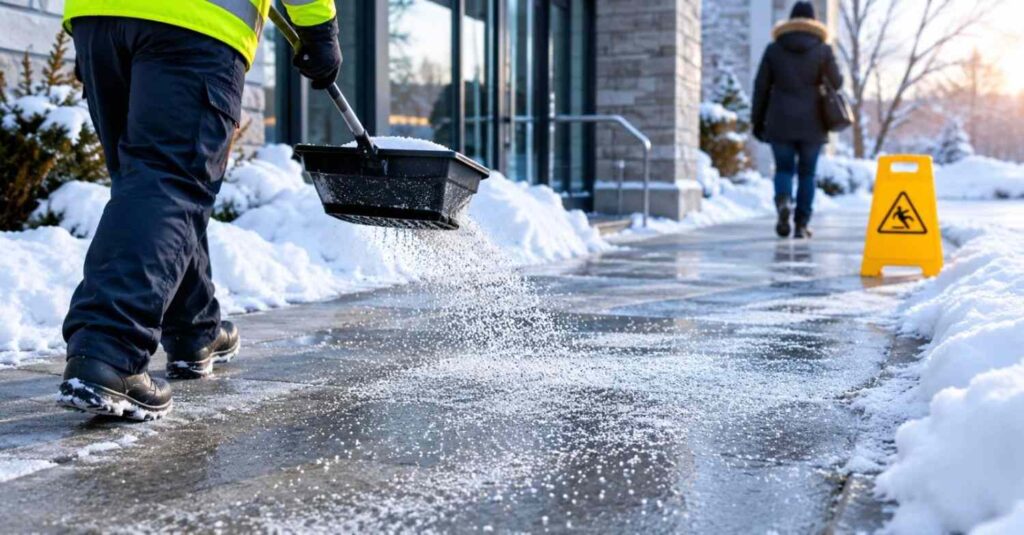
Environmental Considerations When Using De-Icers
Winter safety Albany is the priority, but businesses should also consider how de-icing products affect their surroundings. Salt can travel with melting snow into storm drains, surface waters, and groundwater. Excessive application may also affect plants and some building materials.
There are some good business practice steps that can help reduce unnecessary use:
- Remove loose snow before applying de-icer.
- Use a spreader to distribute products evenly.
- Follow the manufacturer’s recommended application rate.
- Treat specific icy areas rather than automatically covering every surface.
- Choose products appropriate for the expected temperature.
- Collect excess traction material when conditions permit.
- Review recurring problem areas to reduce repeated applications.
The aim is not to try to prevent the need for ice controls. It is to ensure safer surfaces in the responsible use of materials.
Property managers should refer to the New York State Department of Environmental Conservation’s rock salt reduction guidance for further guidance.
Understanding Albany’s Sidewalk Snow and Ice Responsibilities
Commercial property owners and managers must know the rules governing sidewalks and other property areas near their property.
The City of Albany’s published snow and ice guidance and City Code § 323-21 require snow and ice to be removed from adjacent sidewalks within 24 hours of the end of the snowfall. The code also includes situations where the ice is so hard set that it cannot be removed without harming the pavement, and specifies materials like sand or other substances which are permitted for use to make the sidewalk usable.
The city also says that when removing snow and ice, it must not be left in public streets, sidewalks, or crosswalks.
Employers should take into account the existing obligations which apply to their property, such as accessibility requirements and leases or maintenance contracts. The exact duties could be dependent upon the property and the rules.
Please check the City of Albany’s snow removal advice and Albany City Code § 323-21 for the most up-to-date information.
It’s critical to meet local requirements when planning for the winter months, but it’s not enough to assume all surfaces are safe just because they comply with requirements. As weather conditions can fluctuate rapidly, continued monitoring and prompt action are essential.
When Should a Business Hire a Professional Ice Removal Service?
Routine winter maintenance can be accomplished within some small properties using trained personnel and appropriate equipment. For larger or busier sites, they may need to hire a professional service that has the equipment, materials, and manpower required to address dynamic conditions.
Professional Snow & Ice Management Albany NY could be particularly beneficial for:
- Shopping centers with frequent customer traffic
- Office buildings with early-morning arrivals
- Medical facilities with continuous pedestrian access
- Apartment complexes with shared sidewalks and parking areas
- Warehouses with active loading docks
- Restaurants and retail locations with busy entrances
- Properties with large parking lots or recurring ice problems
In comparing providers, consider their weather monitoring process, their focus areas, what de-icing products they employ, and how they conduct follow-up inspections.
It is also important to know how to use the services, what to expect from the services, how it is documented, and how the provider deals with areas that may still be icy after the treatment.
A signed service contract should contain a very clear definition of where the work is to be performed and what type of work is to be performed. No business is obligated to have all of these features as part of a typical package of services from a contractor: sidewalks, ramps, loading areas, or all entrances.
Conclusion
Snow & Ice Management Albany NY is one of the most valuable services provided to commercial properties in the winter to keep the walkways, entrances, ramps, and parking safer. De-icing can be helpful in breaking up existing ice and helping to reduce slippery conditions, but is most effective when combined with timely snow removal, the correct product, frequent checks, and addressing drainage issues.
Pedestrian access, local sidewalk codes, and the impact of overuse of salt should be taken into account when considering these factors. Establishing a clear maintenance schedule in the winter and selecting a maintenance service that’s aware of the building’s requirements will help owners and managers adjust better to the weather.
Frequently Asked Questions
1. What is de-icing in winter property maintenance?
De-icing involves applying suitable materials to help melt existing ice or loosen its bond with paved surfaces, making ice easier to remove.
2. How does de-icing help prevent slips and falls?
It helps reduce ice buildup on walkways, entrances, ramps, and parking areas when combined with snow removal and regular inspections.
3. When should de-icing be performed in Albany, NY?
It may be needed after ice forms, during freezing conditions, or as part of a planned response before forecast icing events.
4. Is rock salt effective in very cold weather?
Rock salt becomes less effective below approximately 15°F. A suitable alternative product or traction material may be needed.
5. Can de-icing replace snow removal?
No. Removing loose snow first helps de-icing products work more effectively and reduces unnecessary product use.
6. Which areas need commercial ice removal most?
Entrances, sidewalks, ramps, pedestrian crossings, parking areas, outdoor steps, and loading zones often require close attention.
7. Does sand melt ice on commercial walkways?
No. Sand mainly improves traction. It does not melt ice and may need to be replenished or collected later.
8. How can businesses reduce salt use during winter?
Businesses can clear snow first, apply measured amounts, treat specific icy areas, and choose products suited to current temperatures.
9. Are Albany property owners responsible for sidewalk ice removal?
City guidance states that responsible property owners must clear adjacent sidewalks within 24 hours after snowfall ends. Check current local requirements.
10. What should businesses look for in a de-icing contractor?
Look for clear service coverage, suitable products, weather monitoring, follow-up inspections, documented visits, and well-defined response procedures.


