
The blog tells about the Best Retaining Wall Designs for Sloped Properties in New York. New York is a city of a thousand forms and faces, from the rugged cliffs of the Hudson Valley to the rolling hills of Westchester to the many different grades of Long Island. These variations in elevation are great for the view, but for homeowners, they can be a big problem sloped yards. If not managed properly, a slope can be an underused space that is subject to erosion and drainage problems.
Placing an investment in a superior retaining wall design NY homeowners trust is the most effective manner to regain your land. With a good design, a steep slope can be an accessible, multi-level platform for patios, gardens or play areas.
This guide will dive into the most popular wall designs in New York’s climate and terrain, along with aesthetics, durability, and the technical considerations of slope landscaping.
1. The Gravity Wall: Timeless Stone Walls
The gravity wall is the preferred choice when it comes to many New York properties, especially those that have a rustic or historic look. These walls are being supported by their own mass and weight only.
- Best materials: Natural field stone, granite, or heavy boulders.
- Design Aesthetic: These stone walls have a more classic Northeast “English Garden” or “Old World” style. They fit easily into the wooded natural landscape of upstate NY.
- The Advantage: They don’t need mechanical anchors in order to achieve shorter beds (typically less than 3-4 feet), making them great for low-profile garden beds.
Local Tip: In places such as the Hudson Valley, use of local bluestone not only helps to support local quarries but also guarantees that the stone is naturally suited to the extreme freeze-thaw conditions.
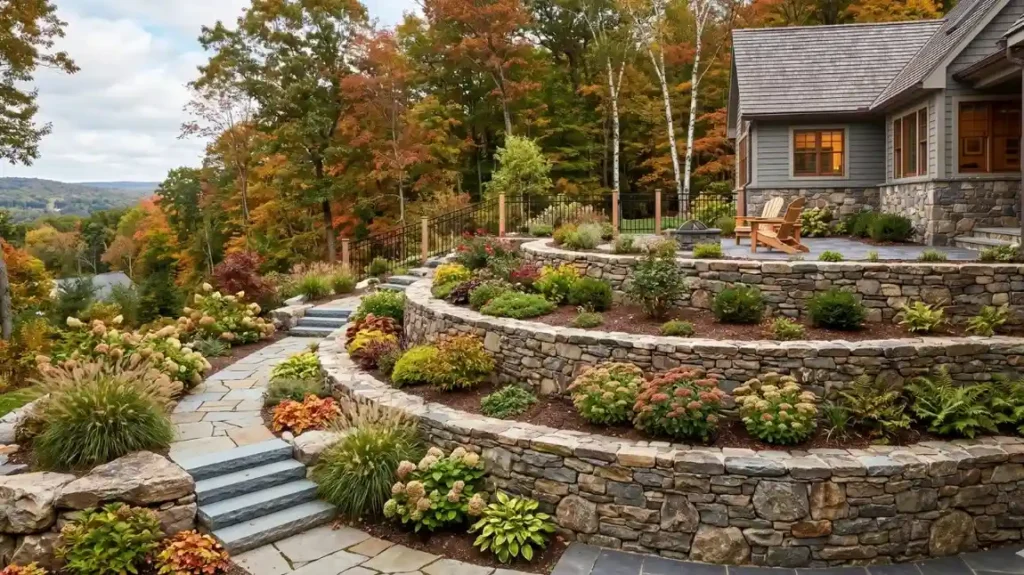
2. Tiered or “Terraced” Walls
On a very steep hill in NYC, a large retaining wall can be too much and require a lot of engineering and costly permits. However, numerous designers prefer to use terraced retaining walls.
You can now create two or three 3-foot walls instead of one 8-foot wall, and place flat ‘steps’ between each wall.
Why Terracing Works for NY Slope Landscaping:
- Pressure Distribution: It disperses the lateral earth pressure into individual segments, thereby making each particular wall more stable.
- Planting Opportunities: The flat tiers created between the walls provide perfect “shelves” for lush greenery, which helps further stabilize the soil with root systems.
- Accessibility: Terraced designs can incorporate stone stairways, allowing easy access to your property.
3. Segmented Block Walls (SRWs)
Segmented Retaining Walls (SRWs) are a design favorite for contemporary homes or projects where the highest level of structural accuracy is desired. Constructed from engineered interlocking concrete blocks.
- Durability: These systems are intended to be flexible. Unlike poured concrete, segmented blocks can flex slightly when the ground moves in the cold winter months in New York, thus avoiding cracking.
- Variety: They are available in a huge range of finishes and colors: from weathered stone to sleek modern slate-gray face.
- The height: These can be made much taller than normal gravity walls because they can be reinforced with geogrid, a high-strength mesh embedded in the soil.
4. Timber and Railroad Tie Walls
Timber walls are more temporary than stone or concrete, but are a more cost-effective alternative for slope landscaping in areas with more rural or wooded areas in New York.
- The Look: They offer a warm, organic, and rustic look, combining harmoniously in cabin-style homes or casual backyards.
- Considerations: Even pressure-treated wood will rot, given the humid New York summer and wet winter weather. Will last 15-20 years, versus 50-100 years that stone can last.
5. Advanced Soil Engineering: Mitigating Clay and Sand Challenges
On a sloped ground in New York, choosing your facing material is just half the job. If you want your structure to last, you need to work with the unique soil mechanics that you are dealing with under your feet. Typically, the soil types in New York properties are polar opposites in terms of the type of stabilization needed to be successful, with each type calling for a completely different approach.
Navigating Upstate Heavy Clay
Heavy, dense clay is a common problem in the Capital Region, Central, and Western New York areas. Clay can hold vast amounts of water, expand greatly in spring thaws, and hold water well into the winter months, like a sponge in the ground.
If clay soil is not controlled behind a wall, it has an enormous lateral force on the wall.
This is why the blueprint of a retaining wall design NY should call for a larger excavation area. In clay conditions, the wall face may need to be covered with up to 24 inches of clean angular stone directly behind, rather than the usual 12 inches of gravel backfill. This expansive gravel chimney will not allow the expanding clay to come in direct contact with the back of your stone walls or concrete blocks, but will instead guide the water safely down.
Stabilizing Coastal Sands
In contrast, if you own a sloped site in Long Island and along the southern Hudson, you probably have very permeable (sandy) soil. Sand drains beautifully and doesn’t have very much cohesive strength, but it does swell when frosted. During heavy rain, a sandy slope will continually slouch, erode, and move under your wall without support.
Even for short walls in these sandy conditions, the use of geogrid reinforcement is a must. These broad plastic-mesh layers are buried deep into the sandy hillside and bind the loose sand into an unbroken, consolidated block of reinforced earth that will not wash away or slide down the hillside.
Technical Essentials for New York Retaining Walls
There’s more to building a wall in New York than choosing beautiful stones. There are technical factors that must be taken into account with our environment, so we don’t have a leaning wall or a wall that collapses after the first winter.
1. Establish a Solid Footing: Depth is key.
A wall has only as much stability as that of the foundation upon which it rests. Here in NY, freezing causes the ground to rise. A level, non-shifting base must be dug and compacted with gravel (not dirt).
2. Manage Hydrostatic Pressure: Drainage is non-negotiable.
The 1 cause of the breakdown of retaining walls is water. A perforated drain pipe (French drain) should be placed behind the wall, and “weep holes” must be provided to allow water to percolate. Otherwise, the wall will be pushed over by the weight of the wet soil.
3. Backfill with Granular Material: Use 3/4.
Do not fill in a retaining wall with regular topsoil. Like a sponge, the topsoil can hold water. Crushed stone or gravel behind the wall to the first 12 inches to ensure that water will flow directly behind the wall to your drainage pipe.
4. Incorporate a ‘Batter’ (Inward Slant): Fighting gravity.
A leaning wall that supports the hill is much stronger than a straight wall that supports it. There is typically a 1-inch setback for each foot of professional design.
Cost Considerations in New York
Remember that labor and materials can differ depending on the region when budgeting your retaining wall design NY.
| Material | Est. Cost per Sq. Ft. (Installed) | Durability |
| Poured Concrete | $60 – $100 | Very High (but prone to cracking) |
| Natural Stone Walls | $50 – $90 | High / Permanent |
| Interlocking Blocks | $35 – $60 | High / Flexible |
| Pressure-Treated Timber | $20 – $35 | Moderate (15-20 years) |
Permitting and Regulations
Many cities in New York (including NYC, Long Island, and Buffalo) have ordinances requiring a permit and design stamped by a licensed structural engineer for retaining walls taller than 4 feet, including the portion below grade. Don’t break ground without consulting with the local building department, or you could face a hefty fine or having to do the work over.
Final Thoughts
Selling a sloped lot in New York can be one of the best ways to boost the value and curb appeal of your home. The foundation and the drainage are the subtle parts of the project that can make all the difference, whether you like the old-world elegance of stone walls or the clean lines of segmented blocks.
Using an appropriate design and engineering to a high standard, you can create a beautiful multi-level sanctuary for generations to come from a steep, eroding hill.
Frequently Asked Questions
1. Do I need a permit for a retaining wall in NY?
In most parts of New York, a permit is required if the wall is 4 feet or higher. Some specific jurisdictions, like New York City, have even stricter requirements. Always check with your local building office before starting.
2. What is the best material for an NY retaining wall?
Natural stone and interlocking concrete blocks are the best for the NY climate. They handle the freeze-thaw cycle much better than poured concrete, which can crack as the ground shifts.
3. How do I stop my retaining wall from leaning?
Leaning is usually caused by poor drainage. When water gets trapped behind the wall, it creates “hydrostatic pressure.” Installing a proper gravel backfill and a perforated drain pipe is the best way to prevent leaning.
4. Can I build a retaining wall on a steep slope?
Yes, but for very steep slopes, it is often better to build a “terraced” system (multiple shorter walls) rather than one tall wall. This is safer, looks better, and often avoids the need for complex engineering permits.
5. How long do stone walls last?
A well-built dry-stack or mortared stone wall can last 50 to 100 years or more. They are among the most durable structures you can add to a landscape.
6. Is bluestone a good choice for New York walls?
Yes, bluestone is an excellent choice. It is native to the Northeast, incredibly dense, and specifically evolved to withstand the temperature swings of the New York climate.
7. How much does a retaining wall cost in NY?
Prices typically range from $35 to $100 per square foot, depending on the material and the complexity of the site. Labor costs in NY are generally higher than the national average.
8. Why is drainage so important for NY walls?
In the winter, wet soil freezes and expands. If your wall doesn’t have drainage, this expanding ice will push against the back of your wall with immense force, eventually causing it to collapse.
9. Can I build a retaining wall myself?
Small garden walls under 2 feet are great DIY projects. However, for anything taller or for walls supporting significant weight (like a driveway), hiring a professional is highly recommended for safety and longevity.
10. What is ‘geogrid’ and do I need it?
Geogrid is a high-strength plastic mesh used to reinforce the soil behind a wall. It is generally required for walls over 3 or 4 feet tall to help “tie” the wall into the hillside.


