
uch more than a barrier to prevent a slope from collapsing. It protects your foundation, maintains the usability of your yard and also aids in stopping the erosion that will gradually form around your home. When the cracks show up, stones move, or one part begins to lean, homeowners have a question that is not always easy to answer – is it a retaining wall repair job or is it time for homeowners to begin considering wall replacement NY
This is a question that can only be answered based on the age of the wall, the degree of damage, the type of material the wall is constructed from and the activity going on beneath the surface. This guide will help you to understand what you need to do to distinguish between the two options, what they entail, and how you can make the right choice to keep your property safe and within your budget.
Why Retaining Walls Fail in the First Place
It is important to understand the reasons for wall failure before determining whether to repair or replace. In western NY, it’s typically freeze-thaw, lack of drainage and age.
One of the most prevalent problems here is freeze-thaw damage. Water penetrates small cracks or porous masonry, freezes, expands and enlarges the crack. Do that ten winters and a well-constructed wall begins to exhibit stress.
Poor drainage is likely to be the greater long-term danger. Retaining walls are designed to prevent soil from flowing away, not water. If the water rises behind the wall and does not pass through the wall, the hydrostatic pressure changes significantly. That pressure is exerted on the wall face and will eventually lead to bulging, leaning or even complete collapse.
Often, people underestimate the role of inadequate original construction. Typical failure mode of walls that are not properly prepared for their base, compacted backfill, and drainage piping is for the walls to fail years before they should. If the wall was installed as part of a hasty landscaping project, and not as a structural landscaping project, then it’s a case of the shortcut paying off now./
There’s also a factor of age and material fatigue. Timber walls are generally considered to have a lifespan of 20-30 years before they start to rot. The average life span of poured concrete and segmental block walls is 50-100 years, assuming they are installed properly. Even poured concrete and segmental block walls, if installed correctly, will have a life span of 50-100 years.
Signs You’re Dealing With a Repairable Problem
Not all cracks and shifts indicate the need for wall demolition. Early diagnosis of many problems will result in simple repairs.
Concrete or mortar cracks less than 1/4 inch wide. Small surface cracks, particularly vertical and less than 1/2″-2mm wide, are frequently cosmetic and/or a result of normal curing and settling. They should be monitored, but are not necessarily indicative of structural failure.
A few loose or shifted stones or blocks. With a segmental or dry-stacked stone wall, each stone may separate as time goes on without affecting the rest of the wall. Usually, resetting these pieces and compaction behind them is sufficient.
Efflorescence and water staining that has not reached the point of causing harm. Sometimes you can see white, chalky mineral deposits on concrete or block walls; they are a symptom of drainage and not a structural problem. Drainage is usually corrected.
Raised areas (under an inch) in a wall that do not affect the stability. In isolated instances where a bulge occurs on one section, but the rest of the wall is plumb and structurally sound, targeted regrading and correction of drainage behind the bulged section may stop the wall from moving.
Growth of vegetation along joints. Weeds and small plants growing into the mortar joints will usually help to deteriorate it, but are not necessarily an engineering problem – if they are noticed, they should be removed before they can grow any further.
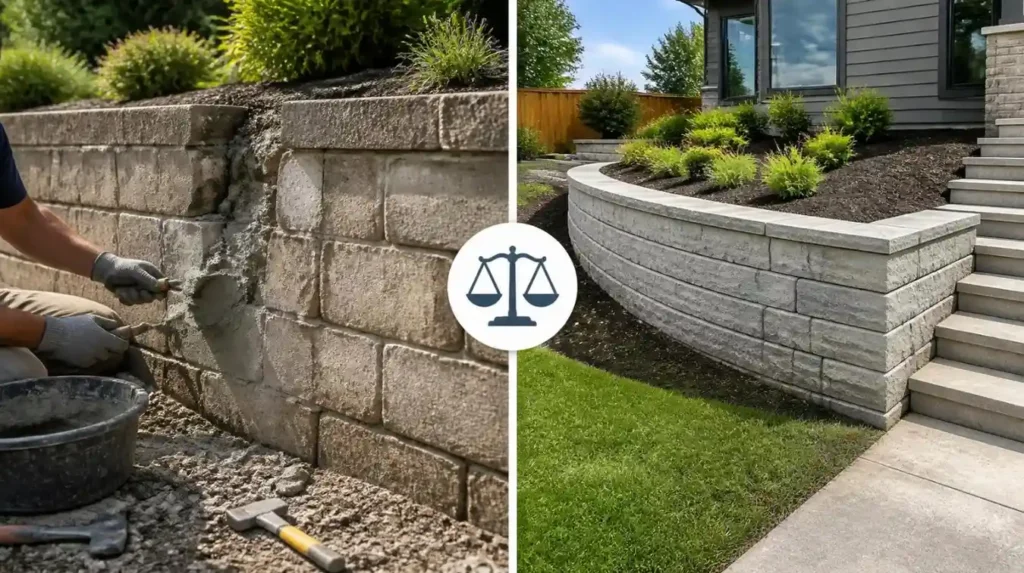
If your wall is in one of these categories, a professional contractor should be able to solve the issue without having to replace the entire wall. In these instances, repairs may involve repointing of mortar, resetting units, installing or clearing drainage pipes, backfilling with gravel and surface crack sealing.
Signs You’re Looking at Replacement
There are clear indications of damage that clearly suggest reconstruction, not patching. Trying a quick-and-easy patch job on a wall that has these problems typically isn’t an effective use of time and resources, and it only postpones the inevitable larger project.
Any leaning or bulging (more than 2″ out of plumb). This typically means that the foundation and/or backfill of the wall has failed. It won’t fix the external force that is still exerting pressure on the wall if it is only patched where you can see it.
Cracks that are more than 1/2 inch wide, particularly horizontal. If a wall has horizontal cracking, the wall is likely being pushed from behind more than the wall design can withstand. This is NOT a cosmetic issue, it’s a structural one.
Collapsed or separated wall sections. The load distribution through the remaining portion of the structure changes once a portion of the wall has failed. Stresses are now greater in adjacent sections than they were designed to withstand.
Soil loss or a failing back or below the wall. This is a clue to internal erosion, also known as “piping,” which is the term used for water that has been moving soil out behind the wall for an extended period of time. The wall might appear sound, but the underlying ground may already be compromised.
A wall that has not been designed by engineers for its strength or support.A wall not engineered for height or load. Walls more than 4 feet high are usually designed with engineering considerations such as reinforcement and footings. In general, if the older or self-made wall in that height interval is in any way distressed, it is better to invest in replacing it with a sound structure.
Multiple repairs to the same area. If you have previously patched the same area in the last few years, then you have not solved the root cause. This is a big indicator that the wall will need to be rebuilt properly instead of being patched up.
What Repair Typically Involves
A repair project typically targets specific and limited problem areas and will not involve the removal of the wall. These are typical repair areas:
- Repointing and sealing cracks: Cleaning up old mortar and replacing it, or filling in existing cracks with sealant to stop water from entering.
- Drainage correction: Installing or clearing perforated drain pipe (French drain) behind the wall, adding gravel backfill and making sure that weep holes are not obstructed.
- Resetting units: Shifting of blocks or stones that have been shifted, with proper base compaction under the stones.
- Re-grading: Grading the top of the soil, away from the wall, to prevent surface water from accumulating against the wall.
- Reinforcement additions: For some walls that are already moving but not yet sufficiently stabilized, helical tiebacks or soil anchors can be added to stabilize the wall, thereby extending its life without requiring reconstruction.
Repair is usually a quicker, easier, and cheaper process than replacement, and less damaging to landscaping. But a repair is only worth the investment if the cause of the damage has been fixed. A crack that is patched, but the drainage problem that is causing the crack is not addressed, will repeat the failure.
What Replacement Typically Involves
The first step of a full wall replacement NY homeowner is to have the failed wall structure pulled down to the foundation, followed by the reconstruction of the wall, including attention to the details that may have caused the original failure. The following are elements of a proper replacement:
- Excavation and removal of the existing wall and frequently some of the soil behind it.
- The design of the bases, such as a compacted gravel footing below the frost line, is important in a region with the freeze-thaw cycles found throughout New York.
- Correct drainage systems (perforated pipe, gravel backfill and geotextile fabric to prevent soil from blockaging drainage layer over time.
- Structural reinforcement, as necessary, for the wall height, including geogrid for segmental block walls, rebar and footings for poured concrete, and engineered tiebacks for taller walls.
- Whether it’s segmental retaining wall block, natural stone, poured concrete or timber, the material was chosen to match the site and budget constraints, as well as desired aesthetic objectives and load requirements.
Replacement will cost more in the short-term and will be a longer process, but will provide a fresh start on the life of the wall and if properly carried out, will relate to the elimination of the cause of failure, not just covering it up.
Cost Considerations
Depending on the material used for the wall, the extent of the damage, and repair costs can be quite variable but tend to be a lot less than replacement costs and may range from a few hundred dollars for the simple pointing and drainage repairs to a few thousand dollars for more extensive partial rebuilding of a portion of the wall.
Costs of replacement vary as per the wall height, length, material and accessibility of the site. The higher the wall, the more materials will be needed, the more engineering will be required and the more digging will be done, increasing costs. Access to the site is important too. It will be more affordable to rebuild a wall that is within the reach of heavy equipment than a wall that requires hand digging or has to be transported long distances.
Before taking any guesses, it’s worth getting a professional assessment. Sometimes a wall may have to be reinforced instead of completely replaced. On the other hand, if the wall seems to be stable on the surface, it could be that there is hidden erosion or backfill failure that may only be revealed during an inspection (which may require a probe behind the wall or a review of the grading).
Questions to Ask a Contractor
When requesting quotes, homeowners should have some specific questions to ask, which can help ensure that they are not just getting a quote based on default settings for the more lucrative option, but also a true reflection of the quote.
- What is causing the damage, specifically, not just what is visibly wrong?
- Is the drainage behind the wall functioning, and how was that determined?
- Was the original wall built to code and engineered for its height?
- What would happen if we only repaired the visible damage without addressing drainage?
- What’s the expected lifespan of a repair versus a full rebuild?
A contractor who can tell the difference between a symptom and a cause, and doesn’t just rush to a quote, is a better indicator of good structural landscaping work than one who does not.
Final Thoughts
There is one basic decision to make when it comes to deciding between repairing or replacing a retaining wall: Has the cause of the damage been determined and can it be repaired without rebuilding the wall? If you have some cracking, loose stones or early drainage problems, you can usually correct the problem with specific repairs. If you’ve noticed there are significant leaning components, there is some horizontal cracking, if it fails over and over in the same area or if there’s obvious soil loss, it’s probably best to replace the unit just to make the investment worthwhile in the long run.
Regardless, it’s all about function: a wall that works to stabilize the slope it is intended to protect, that shields the property behind it and that isn’t a subject of discussion in two years! The first step to determining what works best for your particular wall is a proper inspection by a good contractor.
Frequently Asked Questions
1. How do I know if my retaining wall needs repair or replacement?
Consider the nature and extent of the damage. Small breaks, loose rocks, or stains on the surface typically mean that it can be repaired. If a wall leans more than 2 inches, if there are large horizontal cracks in the wall, or if there is visible soil erosion behind the wall, it is a good indication that the wall needs to be replaced.
2. How long do retaining walls typically last?
It is dependent on the material. The life expectancy of timber walls is 20-30 years, segmental block walls 30-50 years, and corete walls and natural stone walls 50-100 years, provided adequate drainage and maintenance.
3. Can a leaning retaining wall be fixed without replacing it?
If the leaning is minor and is detected early, some can be stabilized by the installation of soil anchors, tiebacks or drainage correction. When a significant lean occurs, it is usually due to failure of the base or backfill and will generally need replacement.
4. What causes most retaining wall failures?
Drainage is the most common cause, because the water can be backed up behind the wall. Other common causes include freeze-thaw events, poor original construction and natural deterioration of the material.
5. Is retaining wall repair cheaper than replacement?
Generally, yes. Repairs are only undertaken in isolated problem areas and generally are much less expensive than a rebuild, but only when the cause of damage is also to be tackled, not just the symptom.
6. Do I need a permit for retaining wall replacement in New York?
Many municipalities have building codes that mandate permits for walls taller than 4 feet because of structural and drainage considerations. The requirements will differ from town to town; call your local building department before beginning any work.
7. What is the best material for a retaining wall replacement?
This is subject to site, budget and wall height. While natural stone is durable and has a natural aesthetic, it may be more expensive than segmental block, and poured concrete is commonly used for taller or load-bearing walls, where its drainage properties are also important.
8. How can I tell if drainage is causing my retaining wall problems?
Symptoms include water buildup at the base of the wall, white mineral stains (efflorescence), soggy soil behind the wall after a rain, or bulging, which increases after heavy rain. A contractor can be hired to check for clogged or missing drainage systems behind the wall
9. Should I attempt retaining wall repair myself?
Small aesthetic jobs, such as resetting a stone or two, may be a manageable do-it-yourself job. Anything involving cracking, leaning, or walls more than a few feet tall, however, should be evaluated and fixed by a professional, and if the cause is misdiagnosed, it will result in larger failures.
10. How much does retaining wall replacement typically cost?
Cost varies according to height, length, material, and access to the site since the larger the wall is, and the longer it runs, the more excavation, material and engineering required. The best and most accurate way to get a price estimate for your project is to obtain an estimate from a local contractor, which is based on the specific requirements for your project.


